
How to Pack a Kitchen for Moving
The kitchen takes 15–25 boxes and longer than any other room. Here’s the order to work in, what to pack last, and what to leave out entirely.
Free referral service · Services are provided by independent third-party providers
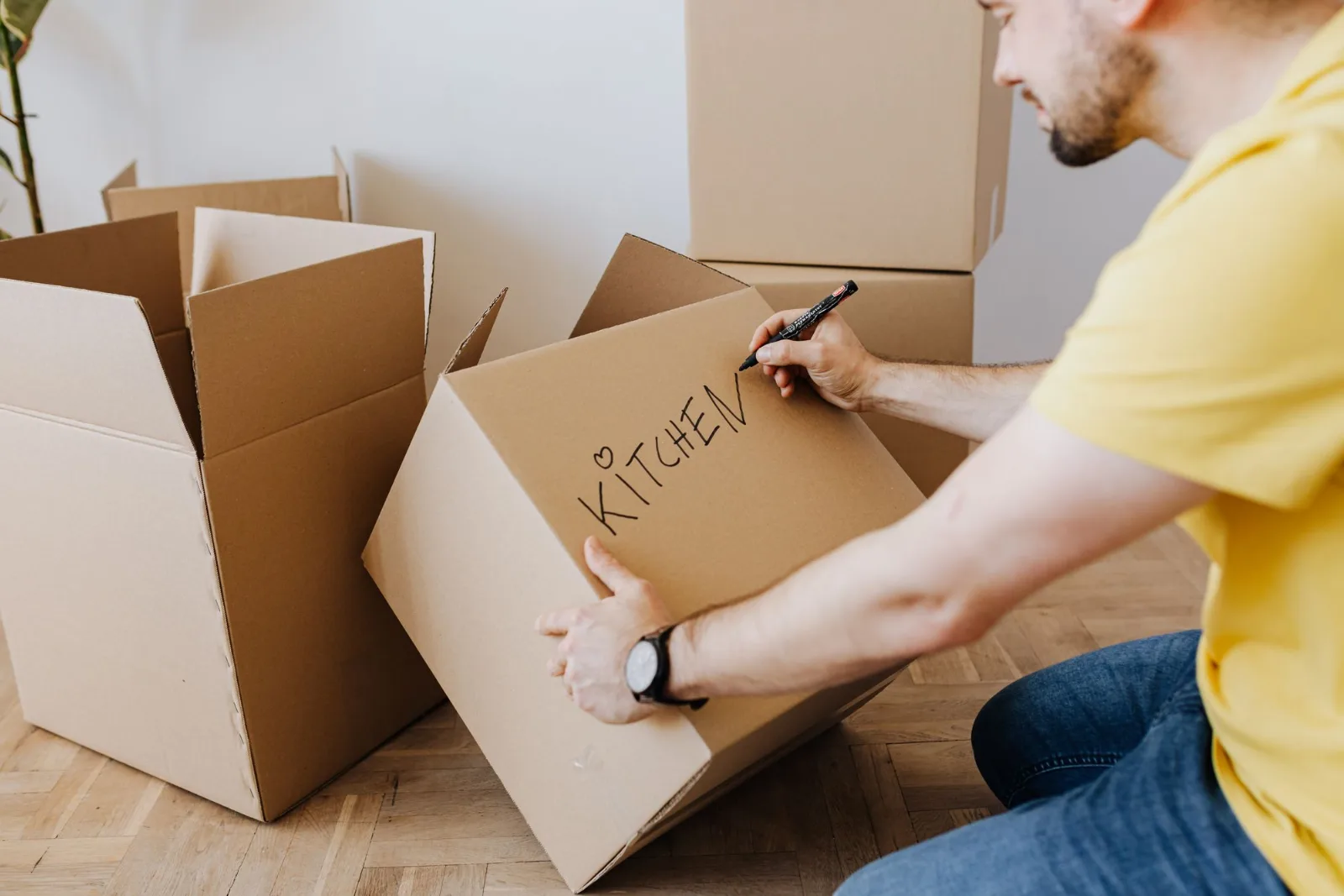
The kitchen is the slowest room in any house — roughly 3.5 packer-hours in a three-bedroom home, about a quarter of the whole job. Budget 8–10 small boxes, 6–8 mediums, 1–2 larges and 4–6 dish packs. Pack it second-to-last and unpack it first. This guide works through it zone by zone, in the order that actually works.
Why one room takes a quarter of the day
Every other room in a house contains a few categories of similar object. Bedrooms are clothing and soft goods. Offices are paper. The kitchen is a hundred unlike items, most of them breakable, none of them stackable with each other, in a space designed for daily access rather than removal.
It is also the room with the most decisions per square foot. Almost everything in a bedroom is coming with you. In a kitchen, a meaningful share is going in the bin — the spices from three years ago, the appliance used twice, the mismatched containers. Every one of those is a decision, and decisions are slower than boxing.
Order of operations
The kitchen has to keep working while you pack it, which is what makes sequencing matter more here than anywhere else.
- Four to six weeks out — purge. Expired food, duplicate utensils, the appliances you have not used in a year. Everything you remove now is something you do not pack, do not move, and do not find a home for later.
- Two weeks out — the rarely used. Formal china, serving pieces, the stand mixer, seasonal bakeware, the second set of everything. None of it will be missed.
- One week out — run the pantry down. Cook from what is in the cupboards. Anything opened, heavy or low-value is not worth moving.
- Two days out — the bulk. Most dishes, most glassware, most pots. Leave out a minimal working set: two plates, two bowls, two glasses, two mugs, one pan, one pot, a knife, a board, a kettle.
- Moving day — the working set and the fridge. Last thing packed, first thing unpacked.
Pack an OPEN FIRST box and put it in your car, not the truck. Kettle or coffee maker, mugs, a knife, a board, dish soap, a cloth, kitchen roll, a bin bag, two plates and cutlery. It is the difference between coffee on the first morning and an hour of opening cartons to find it.
Zone by zone
| Zone | Method |
|---|---|
| Plates & bowls | Dish pack with cell dividers. Wrap individually in unprinted paper, then stack on edge, vertically. Never flat — flat-stacking puts the whole stack’s weight through the bottom plate. |
| Glasses & stemware | Paper inside the bowl, wrap, then upright in cells. Stems never lie down. Heaviest glassware in the lower layer, delicate stems in the top. |
| Mugs | Paper inside, wrap, handles padded. Upright, upper layer. |
| Pots & pans | Nest in threes with paper between each. Lids wrapped separately and stood on edge beside them, not laid on top. Mediums, not larges — weight adds up faster than it looks. |
| Bakeware & sheet pans | Flat, paper between, in a medium. They are the void fill for their own box. |
| Knives | Blade wrapped in paper, then a card sleeve or a folded piece of cardboard taped over the edge, then wrapped again. Label the bundle KNIVES. Never loose in a drawer box — someone unpacks that box by reaching into it. |
| Small appliances | Original boxes if you kept them. Otherwise wrap the body, coil and tape the cord to itself, pad the protruding parts, and put glass carafes and blender jugs in the dish pack instead. |
| Drawers & utensils | Group by function and bag before boxing, so the new drawer is not a lucky dip. Sharp items wrapped like knives. |
| Spices & small jars | Upright in a small box, lined, with paper between rows. Anything opened and older than a year is not worth the box. |
| Oils, vinegars, liquids | Tape the cap, bag individually, upright, in a lined box. Assume every one of them will try to leak. |
| Pantry dry goods | Sealed and bagged. Open packets of flour, rice and sugar travel badly and attract insects — use them or bin them. |
| Under the sink | Cleaning products bagged and upright, kept away from food. Anything corrosive or aerosol does not travel — dispose of it locally. |
| Fridge & freezer | Empty completely. Defrost 24 hours ahead and leave the doors propped open, or you will arrive to mould. |
What should not go in the truck at all
- Anything perishable. On a local move a cooler works for a few hours. Beyond that, give it away or bin it.
- Open flour, rice, sugar, cereal. They spill, and in this climate they attract insects into cartons that will sit closed for days.
- Oils that have been open a while. Heat accelerates rancidity — a Phoenix truck will finish the job.
- Aerosols — oven cleaner, cooking spray. Pressure rises in heat. Genuine rupture risk, and no reputable packer will box them.
- Anything corrosive. Drain cleaner and similar. Dispose of it locally.
- Wine you care about. Wine cooks above roughly 80°F. In an unventilated truck in summer it does not survive. See the summer heat protocol.
This is the shortest list on the page and the one that saves the most grief. A leaked bottle of oil ruins the contents of two cartons; a ruptured aerosol ruins considerably more.
Unpack the kitchen first — and set it up before the boxes arrive
A working kitchen is what makes a house liveable, so ask any unpacker to set it up first. Two things make it dramatically faster.
Decide where things live before the boxes come in. Ten minutes with an empty kitchen deciding which cupboard holds glasses, which drawer holds cutlery, and where the everyday plates go, saves an hour of moving things twice. If a provider is unpacking for you, give them your plan and ask them to follow it.
Shelf liner goes down first. Once the cupboards are full, it is a job nobody does. It takes fifteen minutes in an empty kitchen and never happens afterwards.
A kitchen-only unpack is $200–$450 for two people over two to three hours, boxes and paper removed the same day. For a lot of households it is the single highest-value thing to hire out on the whole move — see unpacking services.
Packing a kitchen — questions
How long does it take to pack a kitchen?
About 3.5 packer-hours in a typical three-bedroom home — roughly a quarter of the whole house. A walk-in pantry or a second fridge pushes it higher.
How many boxes for a kitchen?
8–10 smalls, 6–8 mediums, 1–2 larges and 4–6 dish packs for a three-bedroom home. Full room-by-room counts on how many boxes do I need.
When should I pack the kitchen?
Second-to-last, with a minimal working set left out until moving day. Only the bathroom essentials get packed later.
Can I move food?
Sealed, unopened, non-perishable, yes. Open dry goods, perishables and anything heat-sensitive are not worth the risk in this climate.
How do I pack knives safely?
Wrap the blade, sleeve the edge in folded cardboard, wrap again, and label the bundle clearly. Someone will unpack that box by reaching into it.
Should I use dish packs for everything in the kitchen?
Only for china, glass and stemware. Using a dish pack for pans wastes the box, and pans in a large carton get too heavy.
Can you pack just the kitchen?
Yes — kitchen-only packing is a common partial booking. Rates vary by provider — see packing costs for rough planning ranges. See partial packing.
Compare quotes from local packing providers
Tell us about your move — it takes about two minutes. Free to request, no obligation.